
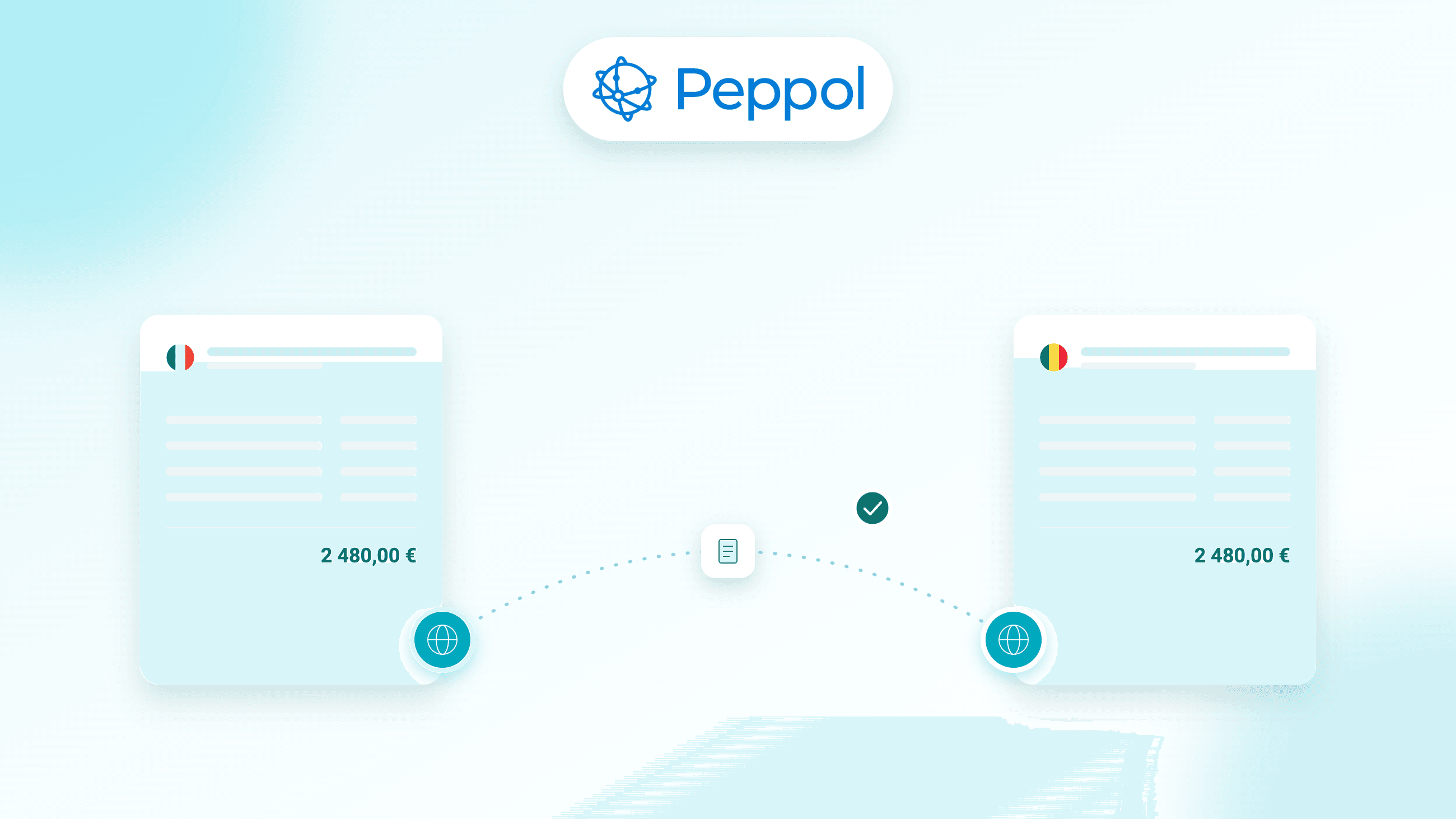
Peppol is a secure network that lets businesses and government bodies exchange electronic invoices and other business documents directly, software to software. Born in European public procurement, it has become a reference infrastructure for electronic invoicing: Belgium uses it to roll out structured B2B invoicing across the board since January 1, 2026, and France gives it an interoperability role in its own reform. Definition, how the network works, its benefits, and the obligations involved: this guide gives small and mid-sized businesses a jargon-free overview of Peppol.
What is Peppol?
Peppol stands for Pan-European Public Procurement On-Line. The project launched in 2008 with support from the European Commission to digitize public procurement, letting businesses invoice government bodies in several countries without juggling a different tool for each one. Since 2012, the network has been run by OpenPeppol, a non-profit international association based in Brussels that maintains the technical rules and certifies participants.
Peppol is neither invoicing software nor a portal where you upload documents by hand. It is an interoperability framework: a set of rules, formats, and services that let different software systems exchange structured documents with each other. The clearest way to picture it is a secure postal network for digital documents — everyone keeps using their own tool, and the network handles delivery.
The network carries electronic invoices and credit notes, but also purchase orders, delivery notices, and electronic catalogs. Its use has grown well beyond its public-procurement origins: Peppol now supports exchanges between businesses as much as exchanges with government bodies, across Europe and beyond, as far as Australia, New Zealand, and Singapore.
How does the Peppol network work?
Peppol runs on what is known as the four-corner model. Behind the technical term, the principle is simple: four parties are involved in delivering an invoice.
- the software of the business issuing the invoice
- that business’s Peppol access point — the certified service provider that connects it to the network
- the recipient’s access point
- the software in which the recipient receives the document
Take a French business invoicing a Belgian customer. The invoice is created in the sender’s usual software, then passed to its access point. That access point identifies the Belgian customer’s access point and sends the document over an encrypted channel. The invoice lands directly in the customer’s own management software, ready to be processed. The two businesses use neither the same software nor the same provider — they are simply connected to the same network, the way two subscribers on different phone networks can still call each other.
The Peppol identifier
Every participant has a Peppol identifier (or Peppol ID), the equivalent of a postal address on the network. Depending on the country, it is built from an existing official identifier: a VAT number, a company registration number (such as Belgium’s BCE/KBO), or another registration number. This identifier is what guarantees an invoice reaches the right recipient.
The Peppol Directory
The Peppol Directory is a public database listing some of the organizations connected to the network. You can search it by company name, country, or identifier, and see which document types an organization accepts. Listing is not automatic: a business can be connected to the network without appearing in the directory, since publication depends on its service provider.
The SMP and SML registries
Behind the scenes, two types of registries keep the network running: the SML (Service Metadata Locator) and the SMP (Service Metadata Publisher). The first locates the registry holding a recipient’s information, and the second indicates that recipient’s access point and the formats it accepts. These lookups happen automatically — there is nothing for the user to configure.
Structured documents, not plain PDFs
Documents that travel over Peppol contain structured data that software can read automatically: invoice number, dates, amounts, VAT rates, order references. The network’s reference format is Peppol BIS, based on the UBL standard. Other structured formats, such as Factur-X or CII, coexist with it inside national electronic-invoicing systems.
Try Toolcie for free
Free plan available. No credit card required. Cancel anytime.
What does Peppol do for a business?
For a small or mid-sized business, the main benefit comes down to one word: interoperability. Without a shared network, every large customer can impose its own portal, its own format, or its own custom EDI project. With Peppol, a single connection is enough to exchange with every organization on the network.
Fewer connections to manage. A connected business can invoice customers running different software and using different service providers, in France as much as abroad, without building a separate integration for each partner.
Less re-keying, fewer errors. A structured invoice loads directly into the recipient’s system. Nobody has to retype amounts from a PDF, which cuts down on data-entry errors and speeds up validation, matching against orders, and, at the end of the chain, payment.
Secure, traceable exchanges. Access points are certified by OpenPeppol and, where one exists, by the national Peppol authority. Documents travel encrypted between identified service providers, with delivery confirmation, so the sender knows the invoice arrived.
An accessible alternative to proprietary EDI. Traditional electronic data interchange relies on bilateral connections negotiated partner by partner, at a cost that in practice puts it out of reach for smaller businesses. Peppol keeps the automated-exchange principle but runs it on an open, standardized network — within reach of a small business running compatible software.
Peppol and France’s electronic-invoicing reform
In France, electronic invoicing between VAT-registered businesses is becoming mandatory in stages. The official reform timeline sets two milestones (source: economie.gouv.fr):
- since September 1, 2026, all businesses must be able to receive electronic invoices. Large companies and mid-sized companies have also started issuing them
- from September 1, 2027, the obligation to issue will extend to small businesses, SMEs, micro-businesses, and freelancers
To issue and receive these invoices, every business goes through a government-accredited platform, either directly or via compatible software. The Portail public de facturation (PPF), run by the French state, keeps two central functions: it holds the national directory that shows where to reach each business, and it centralizes the data sent to the tax authorities. This national directory should not be confused with the Peppol Directory: the former routes invoices within the French system, while the latter lists participants across the Peppol network worldwide.
The PPF, in fact, is not itself connected to the Peppol network. Accredited platforms are what bridge the gap: regulation requires them to be interoperable with each other, either through bilateral agreements or a shared network exchange protocol. That is where Peppol comes in for France. The DGFiP, France’s tax authority, became the national Peppol authority in July 2025: it oversees the Peppol service providers operating in France and sets the network’s requirements on French territory (source: impots.gouv.fr). For invoicing to the public sector specifically, Chorus Pro remains, separately, the reference platform.
Peppol, then, is not the French system itself, but one of the interoperability mechanisms behind it, and its role keeps growing as more platforms connect to it.
This four-corner setup gains a fifth participant in France: the PPF, which receives a copy or structured summary of each invoice in parallel, for tax-control purposes. Some in the industry call this kind of architecture a “five-corner model.” Unlike a clearance model, the invoice is not held up waiting for government approval before reaching the recipient: the DGFiP receives the data alongside delivery, not instead of it. Belgium, for its part, still runs a standard four-corner model for now; a fifth corner is planned for January 1, 2028, with e-reporting run by the FPS Finance.
→ Get ready for these deadlines with Toolcie’s electronic invoicing
Peppol in Belgium: already mandatory
Belgium is ahead of the curve. Since January 1, 2026, structured electronic invoicing has been mandatory for most transactions between VAT-registered Belgian businesses (source: efacture.belgium.be). A PDF sent by email is no longer enough: covered invoices must be issued in a structured format, and by default these exchanges run over the Peppol network, in Peppol BIS format. Exceptions exist, and parties can agree on another channel that complies with the European standard, but Peppol is the standard route set by Belgian lawmakers.
Every VAT-registered business is affected, including those that sell mainly to consumers: at minimum, they must be able to receive electronic invoices from their business suppliers.
What about a French business? Belgium’s obligation covers transactions between businesses established in Belgium, so invoicing a Belgian customer from France does not automatically bring you into scope. In practice, though, that customer will still want to receive your invoices via Peppol, since their system is already connected to it. Being on the network becomes a commercial argument as much as an administrative convenience — in Belgium and in the other countries where Peppol is taking hold.
→ See our dedicated page on electronic invoicing in Belgium
Peppol and Toolcie
Toolcie is compatible with the Peppol network. That compatibility is already active for our Belgian customers: sending and receiving invoices via Peppol has been built into the software since late 2025, through our partner accredited platform SUPER PDP, with no technical setup on their side.
In France, Peppol plays a complementary role alongside Toolcie’s electronic invoicing, issued in Factur-X format: when a customer is reachable on the network, for example in Belgium, the Netherlands, or Germany, your invoice can reach them through that channel, still via SUPER PDP and with no extra steps on your part.
Toolcie covers compliance across the board, wherever you operate: Factur-X for France, Peppol for Belgium, the QR-bill for Switzerland.
→ Discover electronic invoicing with Toolcie
Start your 14-day free trial. Free plan available. No credit card required. Cancel anytime.
Peppol FAQ
Is Peppol mandatory in France? Not directly. France’s reform requires businesses to go through an accredited platform to issue and receive electronic invoices: receiving has been mandatory for all businesses since September 1, 2026, and issuing will become mandatory for small businesses, SMEs, and micro-businesses from September 1, 2027. Peppol is one of the protocols these platforms use to communicate with each other, but it is not imposed on businesses directly.
Is Peppol mandatory in Belgium? Yes, for most exchanges between businesses. Since January 1, 2026, invoices between VAT-registered Belgian businesses must be structured electronic invoices, exchanged by default over the Peppol network in Peppol BIS format. Exceptions and alternative channels that comply with the European standard remain possible in specific cases.
How do I get a Peppol identifier? The identifier is created when you connect to the network, by the service provider or software that connects you. It is built from an existing official identifier for your business, such as its VAT number or registration number. With compatible software like Toolcie, this is handled for you with no technical steps required.
What is the difference between the French directory and the Peppol Directory? France’s national directory, maintained by the Portail public de facturation, shows which accredited platform is responsible for receiving each business’s invoices under the reform. The Peppol Directory is the worldwide directory of the Peppol network: it lets you check whether a partner is connected and which documents it accepts. A French business can appear in both.
What is the difference between Peppol and traditional EDI? Traditional EDI relies on private connections set up partner by partner, with high integration costs. Peppol takes the same principle and runs it on an open network: certified access points, shared formats, and a single connection to reach every participant. That is what makes it accessible to small businesses and SMEs.

Founder of Toolcie
Clément founded Toolcie in 2018 because he couldn’t find the software he needed. He keeps a close eye on the regulatory changes shaping professional invoicing.
View LinkedIn profileRelated articles

Start your 14-day free trial
Join more than 2,000 professionals who save time every day with Toolcie.
Free plan available. No credit card required. Cancel anytime.