
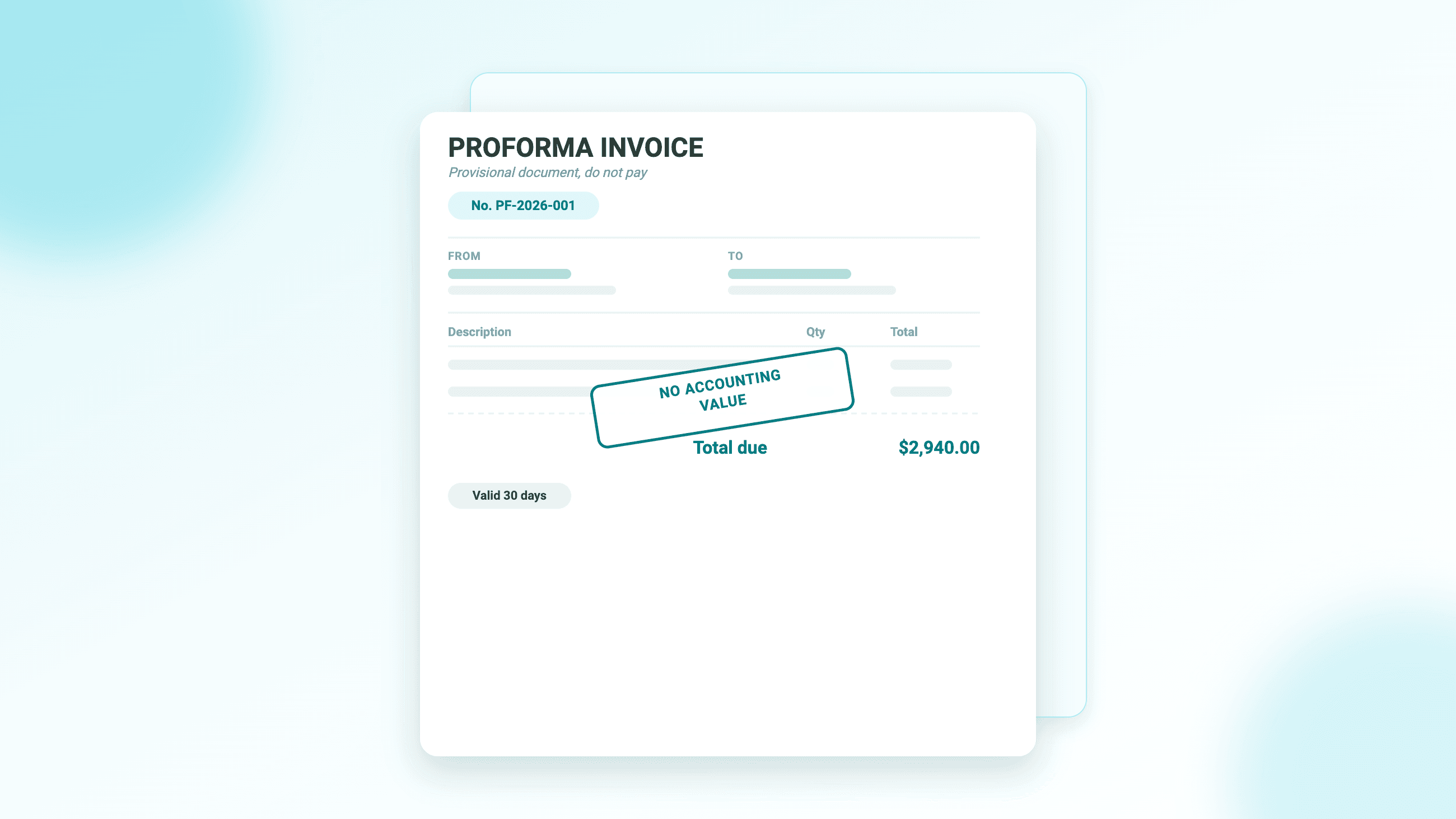
A proforma invoice is a preliminary commercial document that lays out the terms of a future transaction without being an actual invoice. Small businesses and exporters use it to communicate a detailed price before a sale, complete a customs formality, or support a financing request. This guide covers the document’s legal standing, its main use cases, how it differs from a quote and a deposit invoice, what information it should include, and how to convert it into a final invoice.
What is a proforma invoice?
The Latin phrase pro forma means “for the sake of form.” A proforma invoice presents the expected shape and content of a transaction before the sale is definitively invoiced. Customs authorities generally describe it as a quote formatted like an ordinary invoice, one that isn’t recorded in a company’s accounts and doesn’t correspond to any payment.
The document mirrors the essentials of a regular invoice: seller and buyer details, the products or services under discussion, quantities and unit prices, indicative taxes, shipping costs, an estimated total, and the proposed terms. Visually, a proforma looks like an invoice. It must stay clearly identifiable through the label “Proforma invoice” in its header.
A document issued before the transaction
The proforma is drawn up before the goods are delivered or the service performed. It gives the recipient a precise view of what the eventual invoice will contain if the deal goes through. Unlike a final invoice, it stays editable — the seller can correct a quantity or adjust a price without issuing a credit note.
Is a proforma invoice mandatory?
No, this document is optional. A business issues one when it serves a specific need: a complex sales cycle, an international deal, or a counterpart requesting something more formal than a plain estimate. It never replaces the mandatory documents that will still need to be issued once the sale goes through.
What legal value does a proforma invoice have?
A proforma invoice is an informative, preparatory commercial document. It carries no accounting or tax value: it isn’t recorded in the books, doesn’t trigger tax liability, and stays outside the official invoice numbering sequence.
Never an accounting document
A final invoice attests to a completed transaction and carries a unique number within a continuous chronological sequence. The proforma, which corresponds to a transaction that’s still only planned, should never be recorded as a sale or a purchase. Its numbering stays separate — for example, PF-2026-001 for a proforma versus INV-2026-001 for the year’s first final invoice.
Purely indicative tax figures
A proforma can display a pre-tax amount, a tax rate, and a total including tax to give a sense of the likely cost. That tax figure stays estimated: issuing the document doesn’t turn it into tax actually collected, and it doesn’t justify any filing.
A document that doesn’t bind either party
On its own, a proforma doesn’t prove that a sale was concluded, and it doesn’t obligate the recipient to pay. In a dispute, a court looks at the full picture — the signed quote, purchase order, emails, proof of delivery. An accepted proforma can help document the business relationship, but it never stands in for an invoice.
Mistakes to avoid
Recording the proforma as a sale, filing tax on its basis, folding it into the official numbering sequence, or using it to collect a deposit — these mix-ups expose a business to filing errors and, in the event of a tax audit, potential reclassification. To collect money before the work is done, the right document is a deposit invoice.
Try Toolcie for free
Free plan available. No credit card required. Cancel anytime.
When to use a proforma invoice
For exports or a customs formality
This is where the proforma originated. It presents the nature and value of goods shipped abroad when no commercial invoice exists yet, or when there’s no actual sale involved: sending samples, loaned or demonstration equipment, a product return, or a shipment between two branches of the same company.
The declared value feeds into duty and tax calculations and customs checks, so it needs to be established carefully. Once the goods are genuinely being sold, a proforma isn’t enough for customs clearance — customs will require a commercial invoice. Check the exact documents required for your country, carrier, and customs regime.
To support a financing request
Presented to a bank, a proforma details the estimated cost of a purchase — a business loan, equipment financing, or a documentary credit for an import/export deal. It doesn’t prove the purchase actually happened; the lender will later ask for the final invoice or proof of payment.
For internal approval or a bid process
When a purchase needs budget sign-off, a proforma provides a more structured basis than an email: supplier, purchase details, budget, terms, and how long the offer stays valid. The same logic applies in a private bid process — it states the price of a service without prematurely recording an unconfirmed sale.
In construction and trades
Contractors use it to present the expected cost of a job or to support financing before work starts. Don’t confuse it with a progress invoice, which bills for work actually completed so far.
Proforma invoice vs. quote vs. deposit invoice vs. final invoice: the differences
These four documents carry similar information, but they come into play at different moments and produce different effects.
| Document | Value and purpose | Payment request | Recorded in accounts | Issued |
|---|---|---|---|---|
| Proforma invoice | Informative preview of a planned transaction | No | Never | Before the transaction |
| Quote | Commercial offer, binding once signed | No (binds on signature) | No | Before the order |
| Deposit invoice | Real invoice for an upfront partial payment | Yes | Yes | When requesting a deposit |
| Final invoice | Accounting and tax document evidencing the transaction | Yes | Yes | At the sale or delivery |
Proforma vs. final invoice. The difference comes down to whether the transaction has actually happened. The proforma presents a planned transaction — provisional, editable, outside the books. The final invoice attests to a billed transaction, carries an official number, and serves as proof of the debt.
Proforma vs. quote. A quote is a commercial offer that, once signed, seals the parties’ agreement. A proforma is closer to a detailed preview of the eventual invoice — it doesn’t replace the binding quote.
Proforma vs. deposit invoice. A deposit invoice is a real, recorded invoice that collects part of the price before the work is done. A proforma should never be used for that purpose.
What to include on a proforma invoice? Template and example
No legal formalities apply to a proforma. The document still needs to be precise enough to do its job without creating confusion:
- the label “Proforma invoice” as the title, with a clarifying line if useful, such as “Provisional document, no accounting value — do not pay”
- a number dedicated to proformas (e.g., PF-2026-001), kept separate from the accounting sequence
- both parties’ details, including a tax or VAT identification number when the transaction requires one
- the details of the products or services: description, quantities, unit prices, discounts. For an international shipment, add the origin of the goods, their weight, the customs code, and the Incoterms
- indicative amounts: pre-tax total, tax rate and amount, total including tax, shipping costs, currency
- how long the offer stays valid (set freely — 15, 30, or 60 days depending on price volatility) and the proposed payment and delivery terms
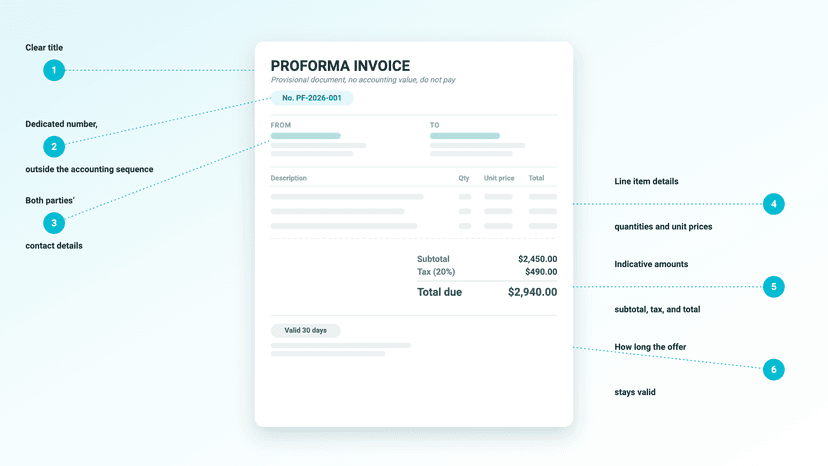
To save time, start from a ready-made template and adapt it to your business.
→ Download a free invoice template
From proforma to final invoice
Once the sale is confirmed, a proforma doesn’t turn into an invoice by simply renaming it. First check the actual details of the transaction: the products or services genuinely delivered, quantities, prices, discounts, tax treatment, and payment terms. The final invoice needs to reflect reality, not an earlier estimate.
Then replace the “Proforma invoice” title with “Invoice” and assign the document a number from the official chronological sequence. The provisional number shouldn’t become the accounting number — keep it as a secondary reference for tracking the file. The invoice then enters the accounts and the tax filings. Invoicing software keeps a record of the proforma while creating a separate, final invoice.
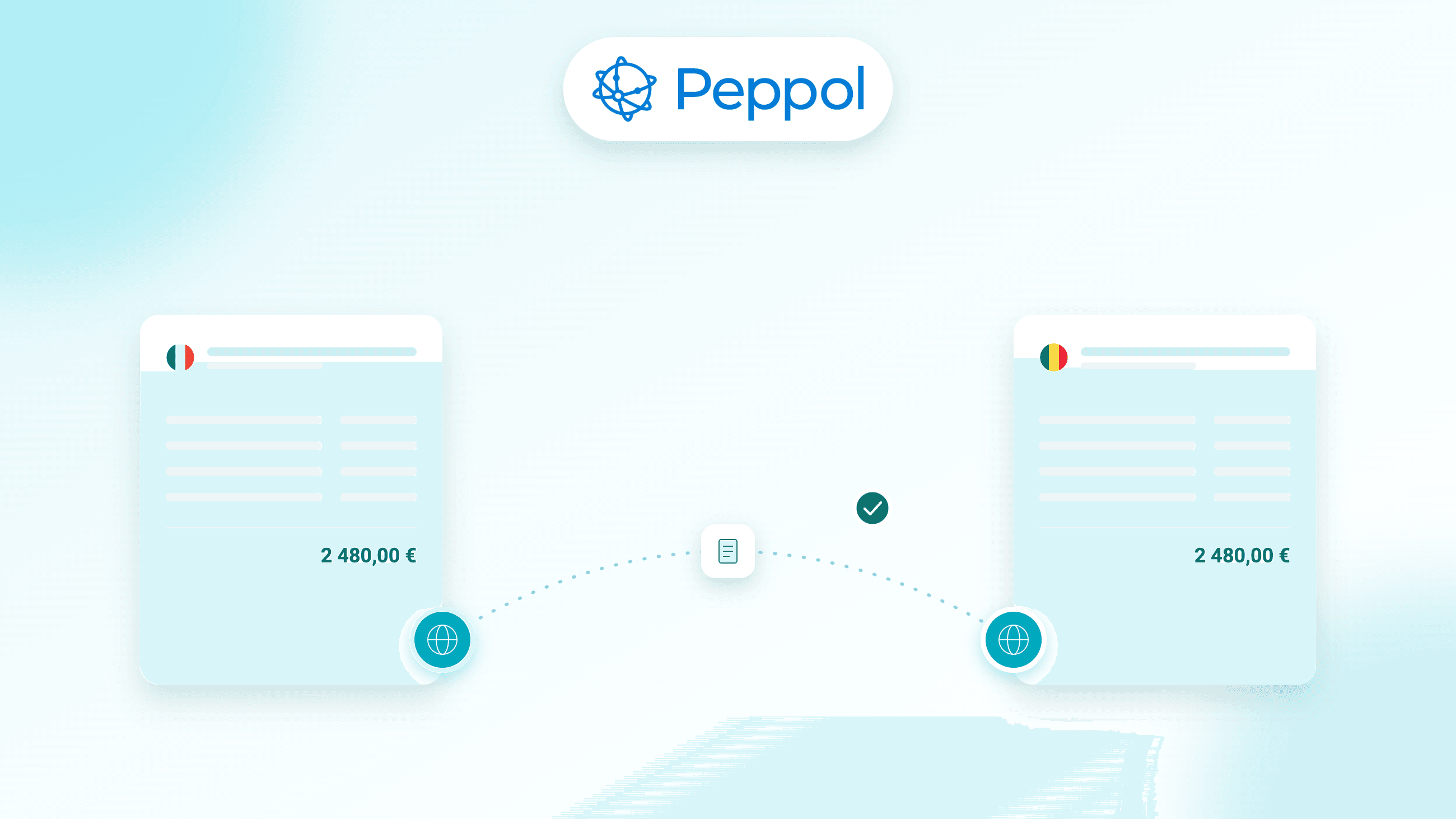
On the e-invoicing side: a proforma, being a preparatory document, falls outside the scope of e-invoicing mandates. The final invoice that results from the transaction, however, may be covered, depending on your country (the FAQ below details the French timeline).
Create a proforma invoice in Toolcie
In Toolcie, a proforma invoice is created from a quote: build it as usual, with details pulled from your client directory, line items with quantities and unit prices, and pre-tax, tax, and total amounts. Then switch its document type to “Proforma invoice” — either directly, or on a duplicate if you’d rather keep the original quote untouched. If that option isn’t in the list yet, click “Manage” to add it. Proforma numbering stays separate from your final invoice sequence, so there’s no risk of mixing a provisional document with an accounting record.
Once the deal is confirmed, open that document’s context menu from the quotes listing page and click “Convert to invoice”: the resulting invoice automatically carries the correct type and an accounting-sequence number, whatever type the source document had. When a formal sign-off is useful, eIDAS-compliant electronic signature is built into the software.
→ Download a free invoice template
→ Discover invoicing with Toolcie
FAQ on proforma invoices
Does a proforma invoice have legal value? No. A proforma invoice is neither an accounting nor a tax document, and on its own it doesn’t obligate the recipient to pay. In a disagreement, it can be reviewed alongside the rest of the file (accepted quote, purchase order, proof of delivery), which is why it’s worth keeping the figures accurate and clearly marking its provisional nature.
Can you collect a payment based on a proforma invoice? No, that’s not the right document. To request money before the work is done, you need a deposit invoice, followed by a final invoice that references the deposit already paid. A client can technically pay after receiving a proforma, but that payment doesn’t remove the need to issue the required accounting documents.
Does a proforma invoice need to be recorded in the accounts? Never. It isn’t taken into account in a company’s accounting and doesn’t correspond to any payment. Simply keep it in the client’s commercial file to track versions and proposed terms.
How long does a proforma invoice stay valid? No legal duration applies — the issuer sets the period freely, often 15, 30, or 60 days depending on price stability and delivery lead times. The expiry date should appear clearly on the document. Once it passes, just issue a new proforma with updated amounts.
Does e-invoicing apply to proforma invoices? No, not in any country. A proforma is never a final invoice, so it always falls outside the scope of e-invoicing mandates. The mandates themselves vary widely by country: in France, for example, all businesses must be able to receive electronic invoices since September 1, 2026, with large and mid-sized companies also required to issue them since that date, and small and micro businesses following from September 1, 2027 (source: economie.gouv.fr). Whatever the rules where you operate, the final invoice resulting from a converted proforma will need to comply with them.

Founder of Toolcie
Clément founded Toolcie in 2018 because he couldn’t find the software he needed. He keeps a close eye on the regulatory changes shaping professional invoicing.
View LinkedIn profileRelated articles

Start your 14-day free trial
Join more than 2,000 professionals who save time every day with Toolcie.
Free plan available. No credit card required. Cancel anytime.